Verdict
Renewable energy uses a very small share of Australian land and will have a negligible impact on Australia’s food security.
Analysis
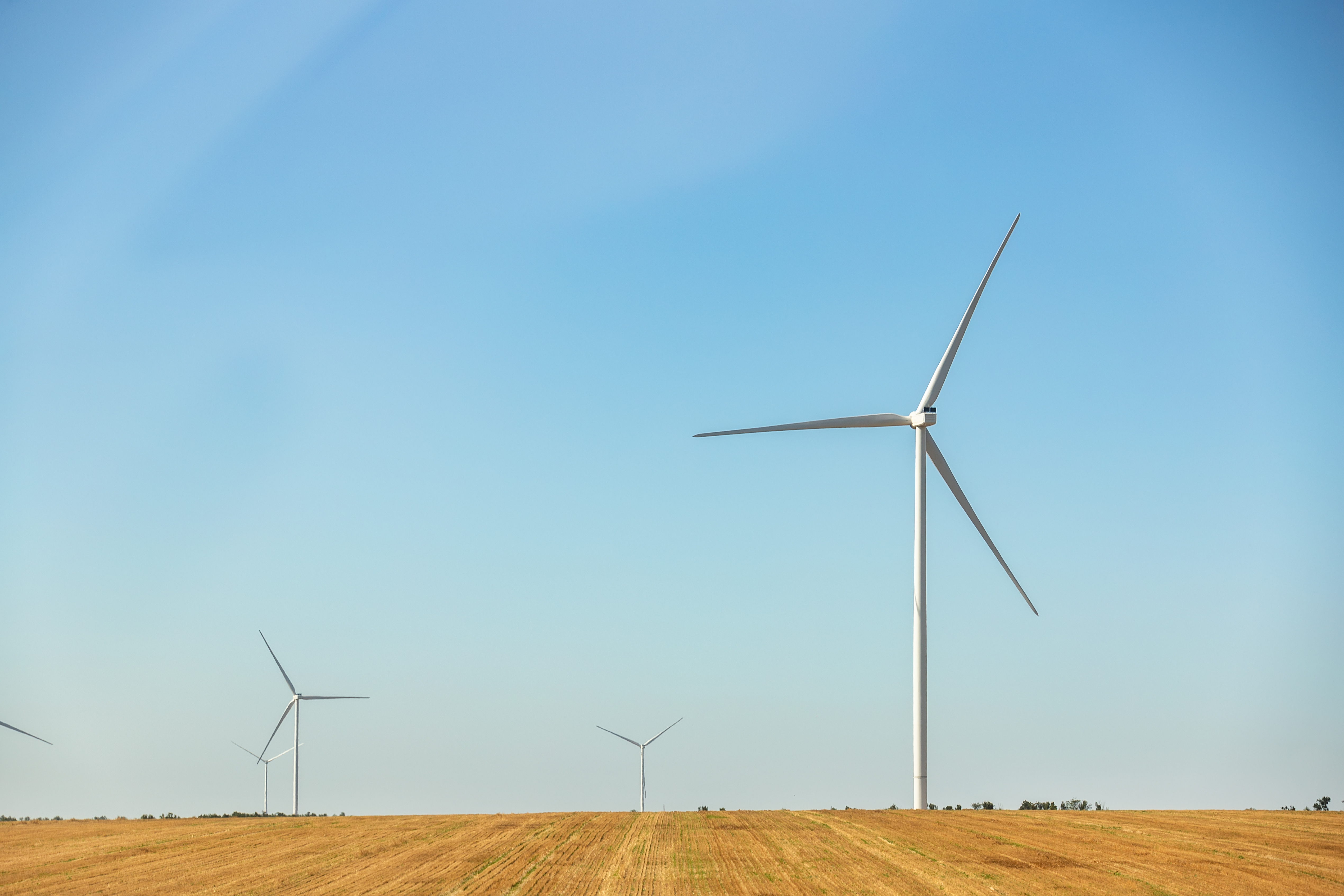
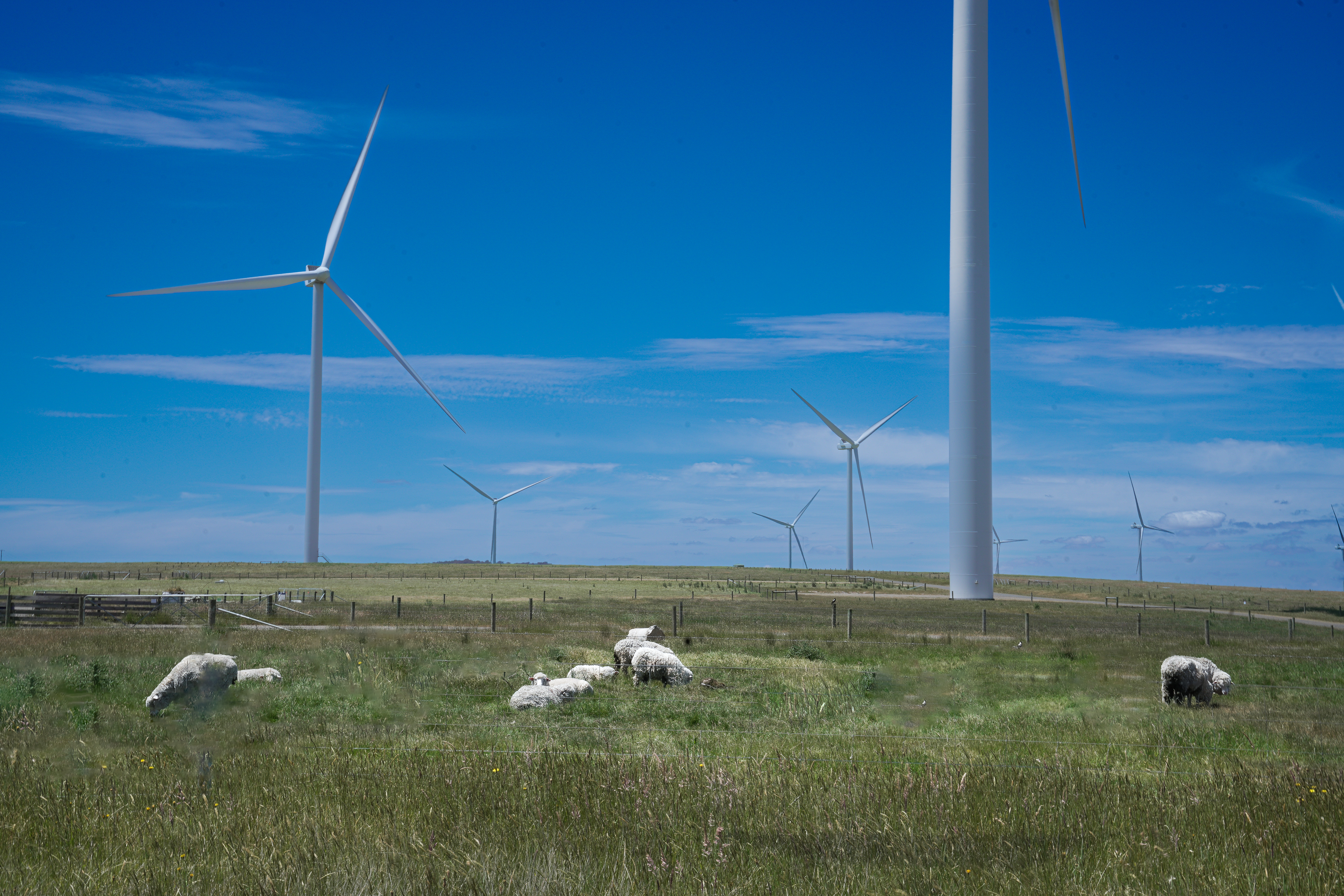
Wind farms and solar farms have different land use profiles, and as such, these technology categories should be considered separately as well as altogether. Wind farms in Australia range in size from a handful of turbines through to over a hundred turbines. While larger wind farms are spread out over quite large areas (more than 100 km2), the turbines themselves, along with access roads and other infrastructure, only occupy around 1% of that land1. The rest of the land remains available for other land uses (e.g. agriculture, plantation forests, conservation).
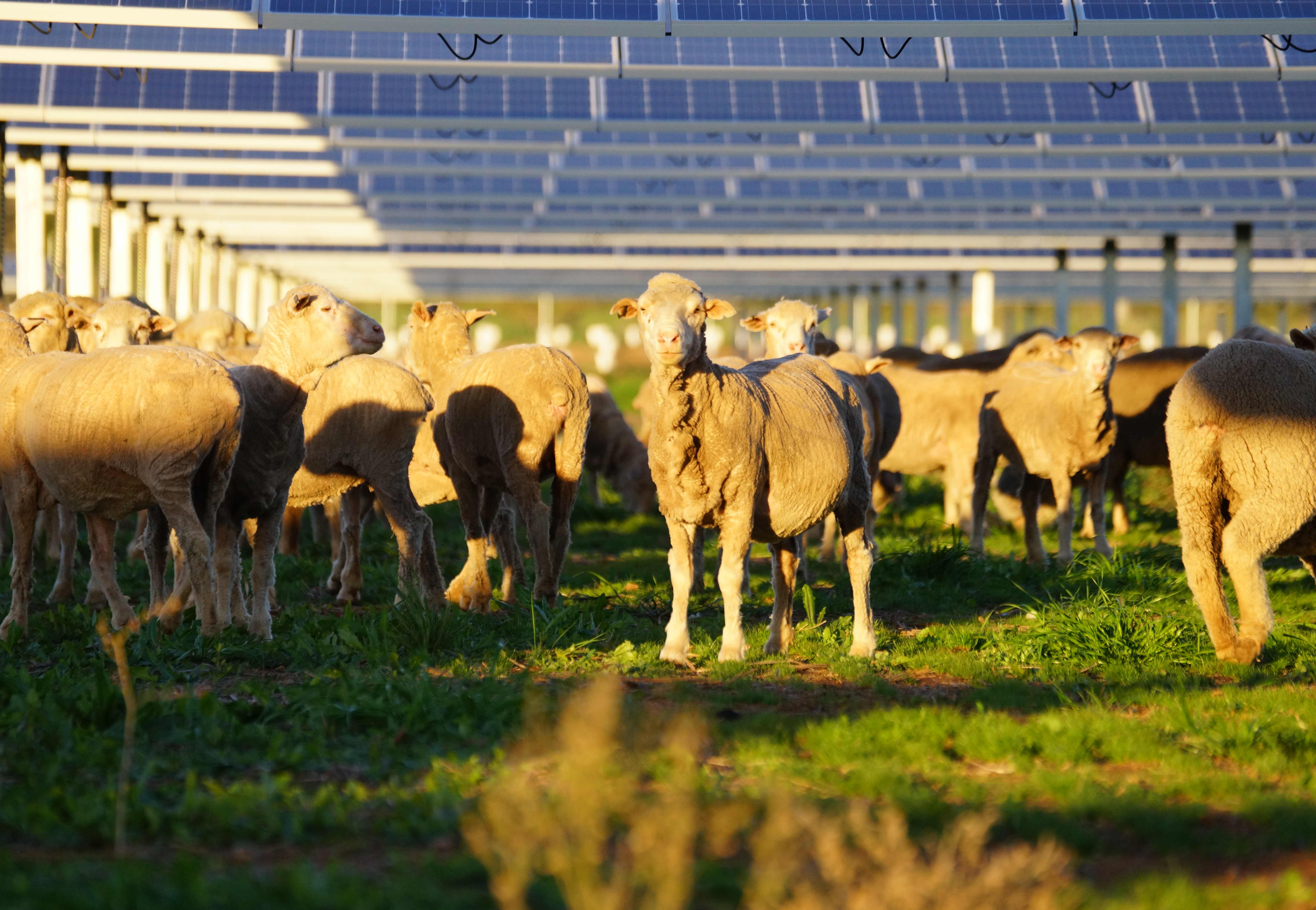
Solar farms are more dense: they contain rows of solar panels that are spaced closely together, but far enough apart that the panels do not cast shade onto the rows next to them. The space between the rows is available for agriculture (or conservation), and sheep farming can and does now commonly occur within many solar farms, delivering positive outcomes for the sheep2 as well as the solar farms. The 400 MW New England Solar Farm is home to 6,000 sheep on the 1,200 hectare site3, which is in the range of typical stocking rates in that part of New South Wales4.
Professor Andrew Blakers from the Australian National University calculated overall land use requirements for 100 per cent renewables. He takes into account the above information about turbine and solar panel spacing requirements, along with future electricity system needs (including growth in demand due to electrification and building new transmission lines) and solar panel and wind turbine efficiency. In conclusion, he finds a total land use requirement of 1,200 km2. Agriculture in Australia currently uses over 4,000,000 km2.
A 2022 study by the NSW Agriculture Commissioner5 found that “renewable energy development is not in conflict with agricultural land use at a sufficiently large scale to materially affect the New South Wales state agricultural base”. It calculates renewables would likely use about 0.1% of rural land. The Commissioner does note that under “worst case” scenarios, some locations that have particularly high concentrations of renewable energy developments could have up to 3% of rural land being used, which could correspond to up to 9% of land classified as “state significant agricultural land” (“SSAL”), which captures a range of higher quality agricultural land categories. However, in practice, renewable energy companies aim to avoid higher-quality agricultural land, firstly because it commands higher lease payments and secondly because state government assessment requirements for renewable energy projects on SSAL are more stringent. It is therefore deemed very unlikely that the majority of renewable energy projects would be located on the highest quality agricultural land. The NSW Department of Planning, Housing & Infrastructure estimates that putting all the state’s solar farms on SSAL would only use 0.4% of that land – even that scenario is considered “highly unlikely”6. Finally, it is worth noting that Australia exports around 70% of its agricultural produce and that it is “one of the most food-secure nations in the world”7. In its submission to an inquiry into food security, the National Farmers Federation has said that Australia produces enough food to feed 75 million people – far more than the current population of around 27 million. In short, the overall insignificant effect of renewable energy on land use will have no effect Australia’s food security.
References
1 – Andrew Blakers. (2024). Australian National University. URL: Detailed_landuse_calculation.pdf
2 – Kampherbeek. E.W. et.al. (2023). A preliminary Investigation of the effect of solar panels and rotation frequency on the grazing behaviour of sheep (Ovis aries) grazing dormant pasture. Applied Animal Behaviour Science, Vol 258. URL: A preliminary investigation of the effect of solar panels and rotation frequency on the grazing behavior of sheep (Ovis aries) grazing dormant pasture – ScienceDirect
3 – RenewEconomy. (2024). More than 6,000 sheep now call Australia’s largest solar farm home. URL: More than 6,000 sheep now call Australia’s largest solar farm home | RenewEconomy
4 – NSW Department of Primary Industries. (2024). Using DSEs and carrying capacities to compare sheep enterprises. URL: Using DSEs and carrying capacities to compare sheep enterprises
5 – NSW Agriculture Commissioner. (2022). Renewable energy generation and agriculture in NSW’s rural landscape and economy – growth sector on a complementary path. URL: Renewable energy generation and agriculture in NSW’s rural landscape and economy – growth sectors on a complementary path
6 – NSW Department of Planning, Housing and Infrastructure. (2022). Large-Scale Solar Energy Guideline. URL: Large-Scale Solar Energy Guideline
7 – Parliament of Australia. (2023). Australian Food Story: Feeding the Nation and Beyond. Chapter 3. Food production, consumption and export. URL: Australian Food Story: Feeding the Nation and Beyond